

Speculation Theory #01
How Harmful Religious Convictions Reinforce Their Own Architecture

“Always the beautiful answer who asks a more beautiful question.” — e.e. cummings
About a year ago, I started wondering — for reasons long forgotten — whether overlaying Simulation Theory on Christianity might help resolve some of the cognitive dissonance inherent in orthodox belief, or whatever passes for it these days.
I quickly discovered I hadn’t explored Simulation Theory enough to have an informed opinion about it.
During that process I began playing around with the phrase Speculation Theory and eventually gave it a working definition.
Speculation Theory begins with the possibility that many things can be true at once. That mind, body, and soul are not separate arenas but parts of one system, and that thought and feeling often illuminate one another more than they compete.
It also recognizes something else: the pursuit of awe often runs against the comfort of certainty.
Certainty stabilizes a system. Awe destabilizes it.
Speculation Theory leaves room for both, but gives awe a little more breathing space.
In other words, this is a place for ideas that wander a bit — ideas not immediately constrained by the banality of doctrine.
Occasionally that may look like a stream of consciousness. Other times it may resemble notes or fragments. Either way, it offers a place where ideas can develop before they harden into arguments.
When I began mapping out the next stretch of essays for this publication, I had about fifteen ideas sketched out — themes, historical threads, questions I wanted to explore.
The plan was simple enough: work through them one by one.
The first essay in that sequence was Mirrors Dimly.
What I didn’t expect was that the next essay would grow out of the comments section.
Two Questions, Several Ideas
A reader named Cindy — who writes under the handle @cknrgwn — left a thoughtful reflection that ended with two questions I couldn’t shake.
She wrote:
“It’s not like Mike Bickle started out good and was seduced by power, status and all that. He was rotten from the beginning. And all that we are watching right now seems to be the same — not just ‘fallen leaders’ but rotten from the get go.”
Which led her to ask two larger questions:
Were some of these leaders actually rotten from the beginning, rather than good leaders who later fell?
If so, what might the deeper metamessage be behind the pattern we keep seeing in these movements?
If I’ve misread Cindy’s questions, I trust she’ll correct me in the comments.
The questions resonated because they were so difficult to answer.
Was the problem really the personalities involved?
Or was something deeper at work?
They shifted my attention away from individual leaders and toward the larger power dynamics I kept noticing — patterns that seem to appear across many systems that eventually become harmful.
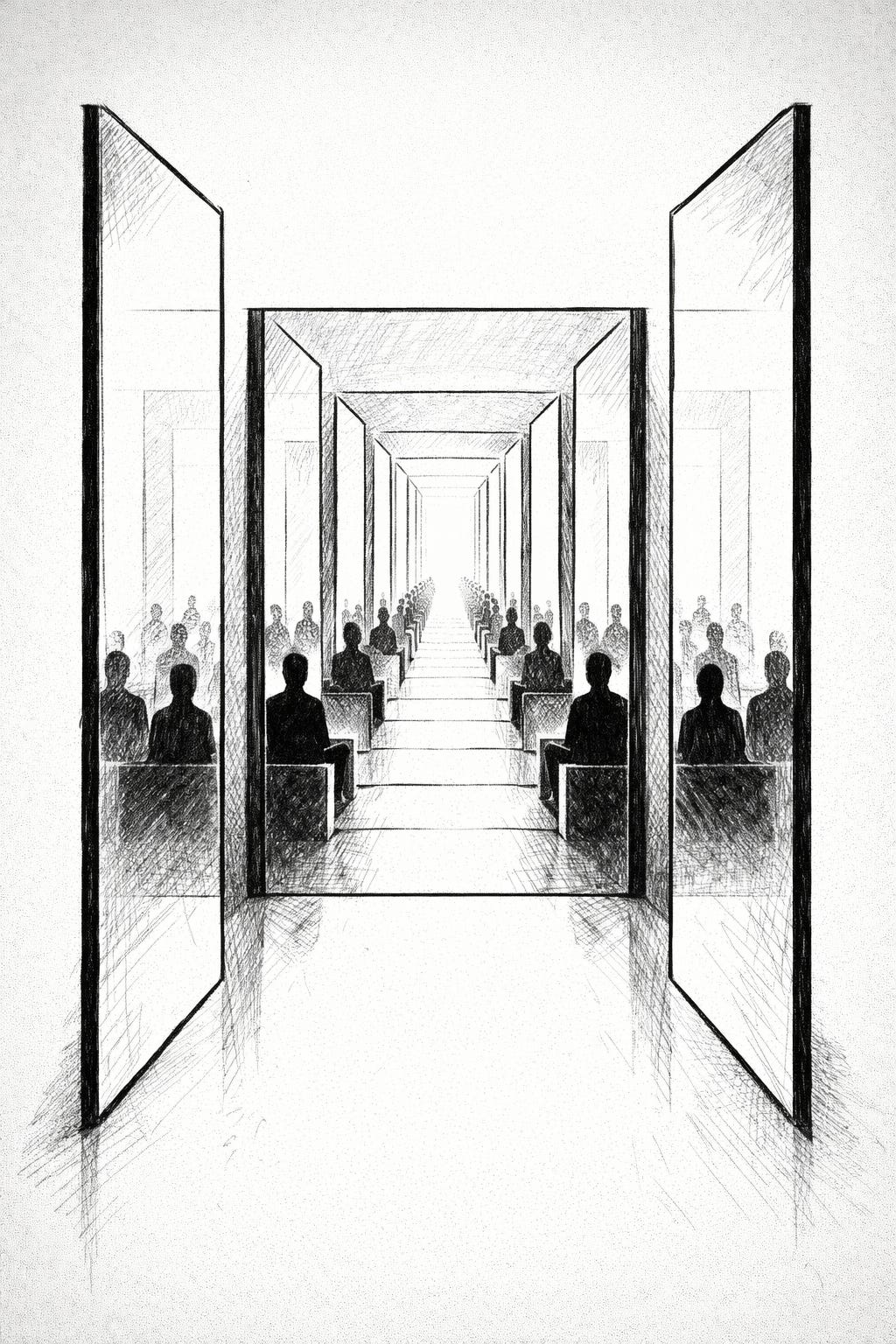
Around the same time I remembered something the philosopher Peter Rollins once observed: every Sunday millions of people gather in orderly rows to worship the most radical nonconformist in religious history.
It’s a strange arrangement when you stop to think about it.
And somewhere in that process of thinking, Kings, Priests, and Carnival Barkers surfaced.
After finishing that piece, I returned to Cindy’s questions. They seemed to point toward culpability. I had already begun sketching an analogy for how responsibility might be distributed.
This felt like a good place to test it.
The System Becomes the Message
There is a concept in common law called constructive fraud.
In ordinary fraud, the elements are familiar: someone knowingly makes a false representation in order to induce another person to rely on it. The victim relies on the representation and suffers harm as a result.
In constructive fraud, the law recognizes that harm can occur even when not everyone involved intends to deceive. The structure of the relationship itself creates the conditions for exploitation. Authority, trust, and asymmetry of knowledge combine in ways that make the outcome predictable even when the participants understand their roles very differently.
The fraud — if that is the right word — may simply be the message itself. Not necessarily a deliberate lie, but a structure that produces the same result.
The claim that certain people possess privileged access to God’s will for the lives of others becomes central.
Inside the system that claim functions as currency, traded, validated, and circulated until it becomes indistinguishable from truth.
Prophetic claims from the privileged organize relationships, direct life decisions, and reallocate time, money, and loyalty. In doing so, they grant extraordinary influence over the lives of others.
In constructive fraud, participants do not all occupy the same role, and whether they believe the claims matters less than how they help sustain the larger deception.
At the top are the architects — a small number of leaders who construct and maintain the system.
Some of them may know exactly what they are doing.
Others may simply recognize that the structure works and continue reinforcing it.
Beneath them are the true believers in leadership, the pastors, prophets, and teachers who sincerely accept the framework and repeat its claims with complete conviction.
They often believe every word they say. But sincerity does not prevent the system from functioning.
It lubricates it.
Then there are the ordinary participants — the congregants, volunteers, and young believers who internalize the message and begin repeating it themselves.
At that point the system becomes self-propagating: a prophetic word is shared; a testimony confirms it; the story is repeated; a life decision follows; the outcome is then cited as evidence that the prophetic word was from God.
These categories aren’t rigid. They’re simply a framework for thinking about how responsibility and influence move through a system, not just in religious movements, but in almost any structure built around authority and belief.
In practice, the lines blur constantly.
A person might begin as an ordinary participant, become a sincere leader, and eventually help sustain the very structure they once simply trusted.
Someone near the top of the system might believe the entire structure with complete sincerity.
Conviction has a way of reinforcing its own architecture.
Which brings Cindy’s question back into focus.
Were some of these leaders rotten from the beginning?
Possibly.
But the more troubling possibility is that it may not even matter.
Harm emerges regardless of intent.
The Bright Side of Trajectory
I don’t want to end the first installment of my new brand on a downer.
So here’s an uplifting question: Have I already sown the seeds of my own moral decay?
Only a few more steps are required to complete a fairly predictable formula.
I stumble onto some old practice. (brainstorming)
I confuse discovering something with inventing it. (Speculation Theory™)
I give it a clever name. (see above)
I brand it.
I repeat it often enough that the brand starts to feel like my identity.
At that point criticism of the idea begins to feel like criticism of me.
Which means I’ll become instinctively defensive and filter all new information through the lens of my brand.
And before long I’ll be doing the very thing I once set out to critique.
In fiction they call this foreshadowing.
In real life it’s more like trajectory.
And it sounds boring.
Stephen - You captured my intent perfectly. And here’s my “note to self,” If I focus on my question to you, “Were they (Bickle et al) rotten from the beginning?” I WILL MISS the bigger picture. It doesn’t matter because harm emerges regardless of intent. I have to step away from the symptom and look at the cause. Your statement in regard to the constructive fraud “ (it) may be the message itself, not necessarily a deliberate lie, but a structure that produces the same results. We often believe every word said, but sincerity does not prevent the system from functioning. And this is the kicker.... “It lubricates it.” We begin as participant, progress to leader, sustain the structure…. God have mercy on us all
I’ve always felt like an outsider looking in. Not fitting the mold. People all around me get sucked into their imaginary portals and freaky supposed encounters, fake gold & gems, insane laughter, crazy tales of all sorts, worshipping mere mortals as if gods, and I stand back wondering why and how seemingly intelligent human beings can be so easily manipulated and sucked in. It’s frightening.